What Is Prompt Engineering? The Ultimate Guide for Beginners
Last Updated: July 2026
The rapid rise of artificial intelligence (AI) has completely changed how we work. Today, tools like ChatGPT, Claude, Gemini, Midjourney, and Leonardo AI are no longer just cool tech toys; they are essential business tools running global operations. Millions of people use these tools daily by typing a quick sentence and waiting for results.
However, there is a massive difference between a casual user who uses AI for basic fun and a professional who directs these models with absolute precision to solve complex corporate problems. This critical gap is where a brand-new skill comes into play. If you want to unlock the true power of modern AI software, you must understand the basics. But before diving into the engineering part, it helps to read our foundational guide on what is a prompt and how its core mechanism works.
Once you know what a prompt is, you are ready to answer the bigger question: What is prompt engineering?
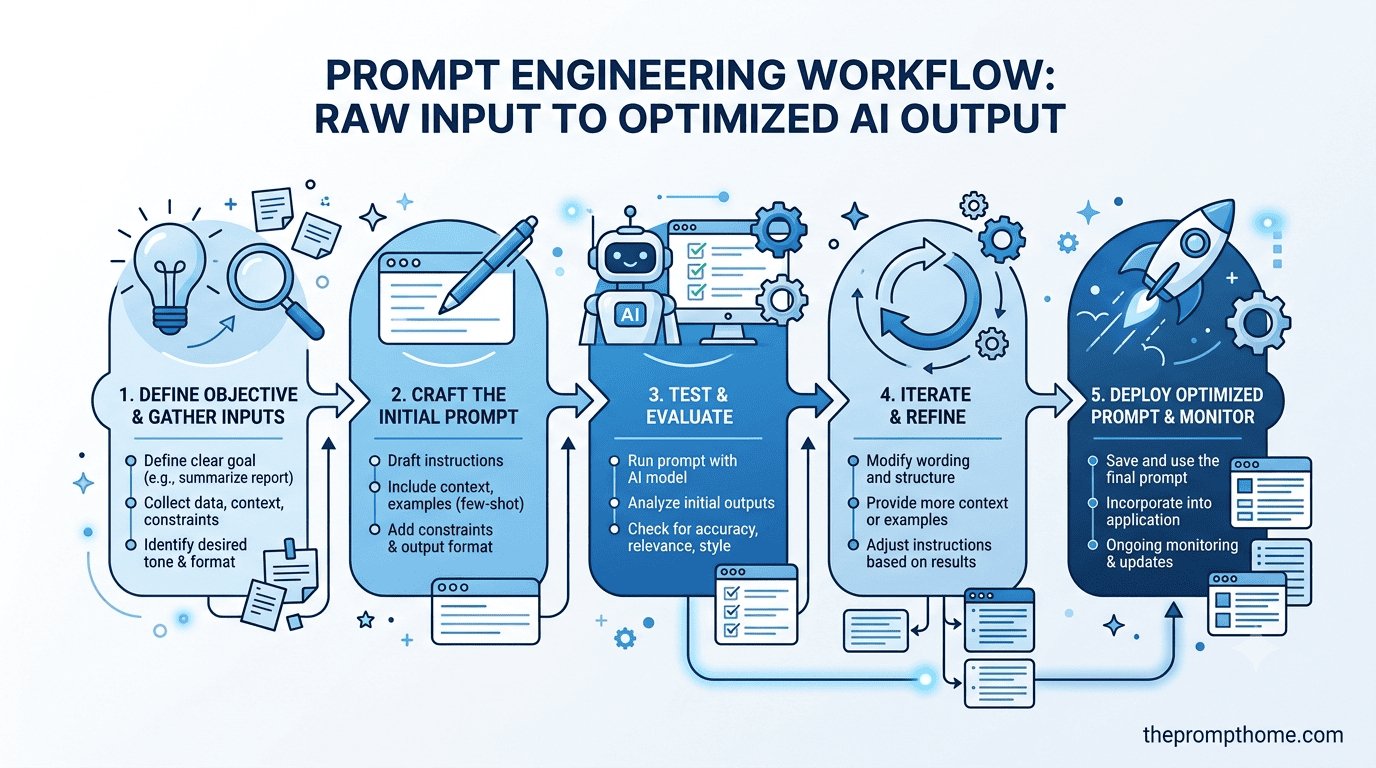
What Is Prompt Engineering? (Core Definition)
To build a solid foundation, let’s define this discipline in simple terms:
Prompt engineering is the daily practice of designing, editing, and organizing natural language inputs (words) to guide artificial intelligence models into producing accurate, structured, and reliable outputs.
Many people make the mistake of assuming that this field is just about being good at English or having a large vocabulary. That is a massive misconception. While clear words matter, this skill is deeply rooted in logic, clear context, and structured layouts.
When you write a professional-grade instruction, you are essentially setting up a digital maze with strict walls. You tell the machine who it is, what background data it must focus on, what logical steps it must follow, what mistakes it must avoid, and exactly how the final text or image must look. By doing this, you eliminate random guessing and turn a chaotic AI system into a targeted, high-performance tool.
The Prompt Home Experience
During our extensive testing across ChatGPT, Gemini, Claude, and Midjourney, we found that structured prompts consistently produced better and more predictable results than simple one-line requests. While no AI model is perfect, adding clear context, role instructions, and specific formatting requirements noticeably improved overall output quality and eliminated unnecessary revisions.
The Conceptual Shift: User vs. Engineer
To understand this clearly, think of a simple car analogy. A regular driver knows how to turn the key, step on the gas pedal, and steer the car down a straight road. But a mechanical engineer understands how the engine runs, how the fuel system behaves under pressure, and how to tune the vehicle to achieve maximum speed and efficiency.
AI Prompting Approaches
| Feature | Casual AI User | Professional Prompt Engineer |
| Input Style | Vague, single-sentence queries. | Structured, context-driven templates. |
| Output Quality | Generic, often requires heavy manual rewriting. | Organized, deployment-ready, and highly accurate. |
| Core Focus | Random guessing and quick answers. | Logical constraints, parameter control, and system efficiency. |
The casual user types a surface-level question like “Write a business plan” or “Create a cool picture of a building.” They accept whatever generic answer the machine spits out, often spending hours manually correcting flawed data.
The prompt engineer understands how neural networks process information, word limits, and backend settings. They do not just ask questions; they design highly specific text templates that help the AI generate more structured and consistent outputs on the very first attempt. Learning this skill means moving away from random guessing and moving toward a structural science where everyday language becomes a form of programming code.
Why Prompt Engineering Matters in 2026
We have officially moved past the phase of AI novelty. In 2026, tech giants are investing billions of dollars not just in building bigger models, but in making them more controllable.
Here is why structured input design has become a critical skill of the modern digital era:
1. Saving Computing Power and Costs
Running large-scale models requires massive amounts of server power and money. Every single word an AI processes carries a cost. Businesses cannot afford to have employees running twenty vague inputs to get one usable piece of data. Mastering these mechanics allows professionals to reduce operational costs by getting the desired result in a single prompt and response.
2. Overcoming Machine Hallucinations
AI models are statistical engines; they predict the next most likely word based on patterns. When an AI does not have enough context or clear boundaries, it frequently invents false facts, incorrect lines of code, or flawed historical events—a phenomenon known as “hallucination.” A well-engineered prompt creates strict parameters that keep the AI grounded, ensuring the output is factually accurate and safe for commercial use.
3. Bridging the Gap Between Code and Creativity
In the past, if a company wanted to automate its customer service line or design marketing assets, it had to hire a team of software developers to write complex code. Today, clear conversational instructions can build those automated systems smoothly. This empowers non-technical creators, marketers, and business owners to build advanced automated workflows without writing traditional code.
Core Skills Required to Become a Prompt Engineer
Becoming a highly skilled specialist in this space does not require a formal degree in computer science. However, it does require a specific blend of technical awareness and logical thinking.
Technical Skills
Understanding Model Behavior: You must learn how different models behave. For instance, Claude excels at handling long documents and dry analytical data, while ChatGPT is great at creative brainstorming and structural formatting.
Token Awareness: AI models do not read entire books at once; they process text in small clusters called tokens. An expert engineer knows how to keep instructions concise so they do not exhaust the model’s memory capacity.
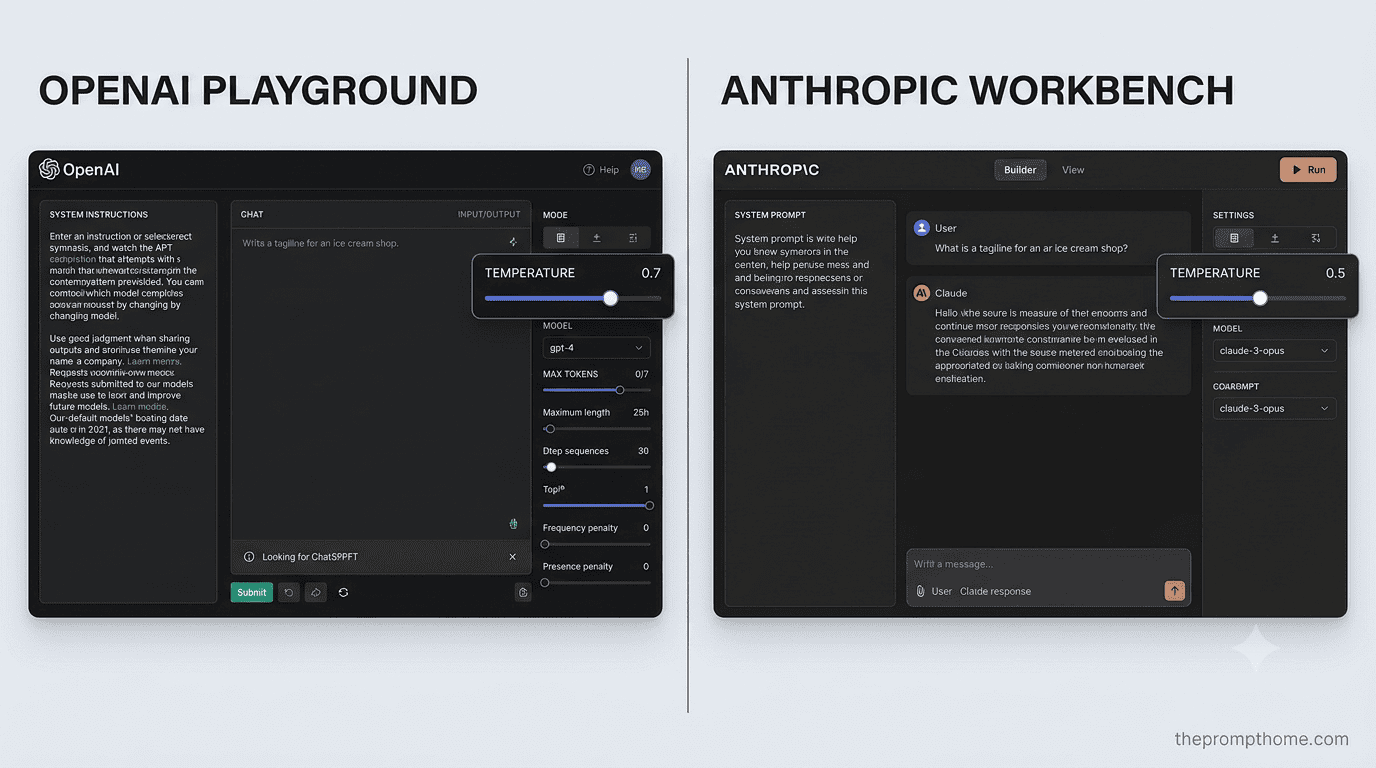
Parameter Control: Professional testing dashboards feature adjustment sliders like Temperature (which controls how creative or predictable the AI’s answers are) and Top-P. Knowing how to adjust these backend settings changes the entire nature of the response.
Soft Skills
Critical Thinking & Logic: You must be able to dissect a massive business problem and break it down into a sequence of small, logical steps that a computer can easily process.
Linguistic Precision: Avoid using emotional, vague, or decorative adjectives. An engineer uses direct, clear action verbs and exact structural constraints.
Patience and Iterative Testing: Perfecting a prompt template for a major website or app requires constant testing, editing, and adjusting until the system runs smoothly every time.
Advanced Prompt Engineering Techniques (With Live Examples)
To help you move from a beginner to a true professional, let’s break down the four most powerful structural techniques used by industry experts. If you want to see how these apply to specific text tasks, explore our comprehensive vault of ChatGPT prompt examples.
1. Zero-Shot Prompting
This is the simplest form of interaction. You give the AI a direct command without providing any prior examples or background explanations. It relies entirely on the model’s pre-existing knowledge base.
Casual Text Example: “Write a product review for a phone.”
Engineered Text Example: “Act as an unbiased tech reviewer. Write a 100-word product pros-and-cons breakdown for the iPhone 15 Pro, focusing entirely on its titanium frame durability and battery life. Use bullet points.”
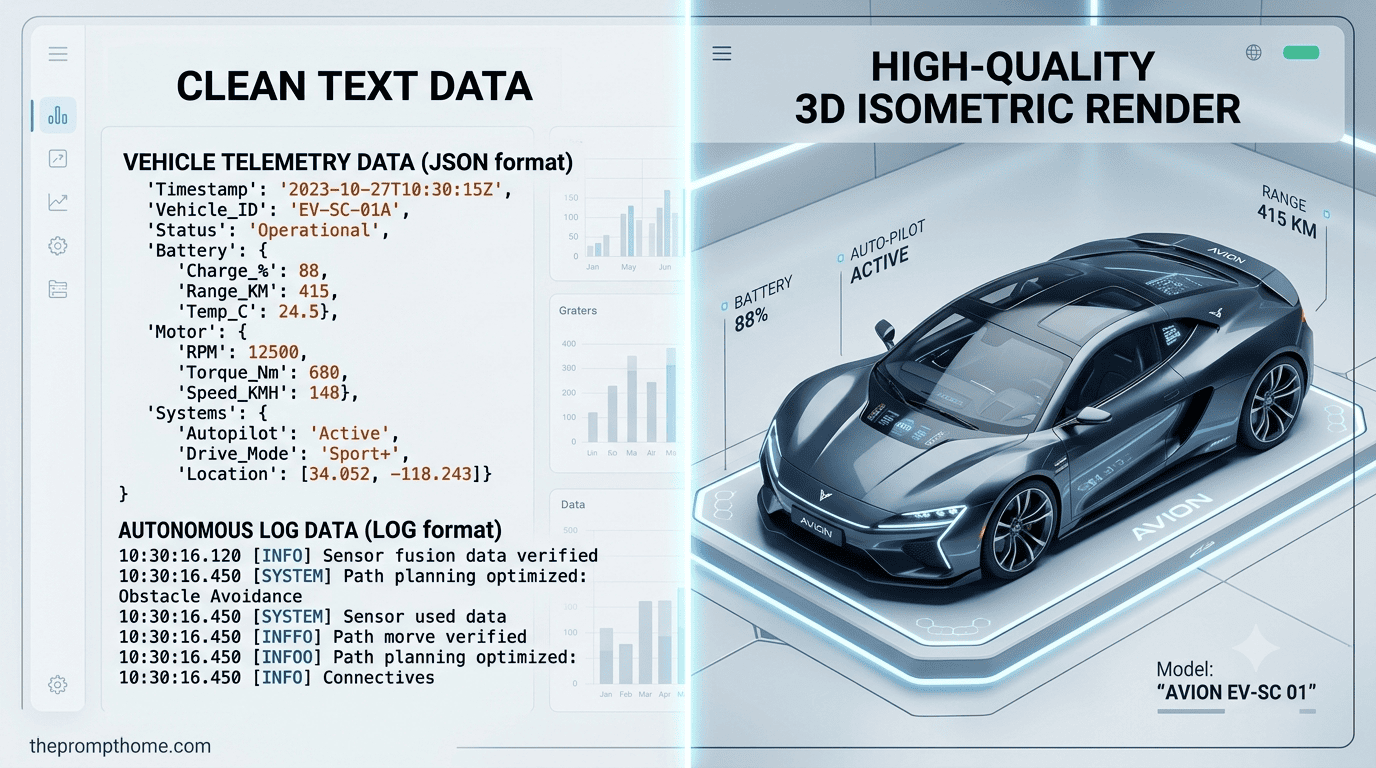
Casual Image Example: “A photo of a futuristic car.”
Engineered Image Example: “A sleek 3D isometric render of an electric autonomous sports car driving through a rain-slicked city street at midnight, neon pink and cyan reflections on the wet asphalt, minimalist studio backdrop, high texture fidelity, 8k resolution –ar 16:9”
2. Few-Shot Prompting
When you need the AI to follow a highly specific design layout, formatting style, or artistic tone, you use Few-Shot Prompting. This means you paste one or two successful examples directly into your instruction window before asking the AI to process your actual request.
Few-Shot Text Template:
Plaintext
You are an AI assistant that classifies the emotional tone of customer feedback into three categories: Positive, Neutral, or Negative. Review these examples:

Feedback: "The shipping took three weeks to arrive and the box was completely crushed."
Sentiment: Negative

Feedback: "The product works exactly as advertised on the website, nothing special but it does the job."
Sentiment: Neutral

Feedback: "This is the best customer service experience I have ever had! My issue was resolved in five minutes."
Sentiment: Positive

Now, classify this specific text string:
Feedback: "The material feels slightly cheap, but considering the low price point, I am satisfied with my purchase."
Sentiment:
Few-Shot Image Strategy:
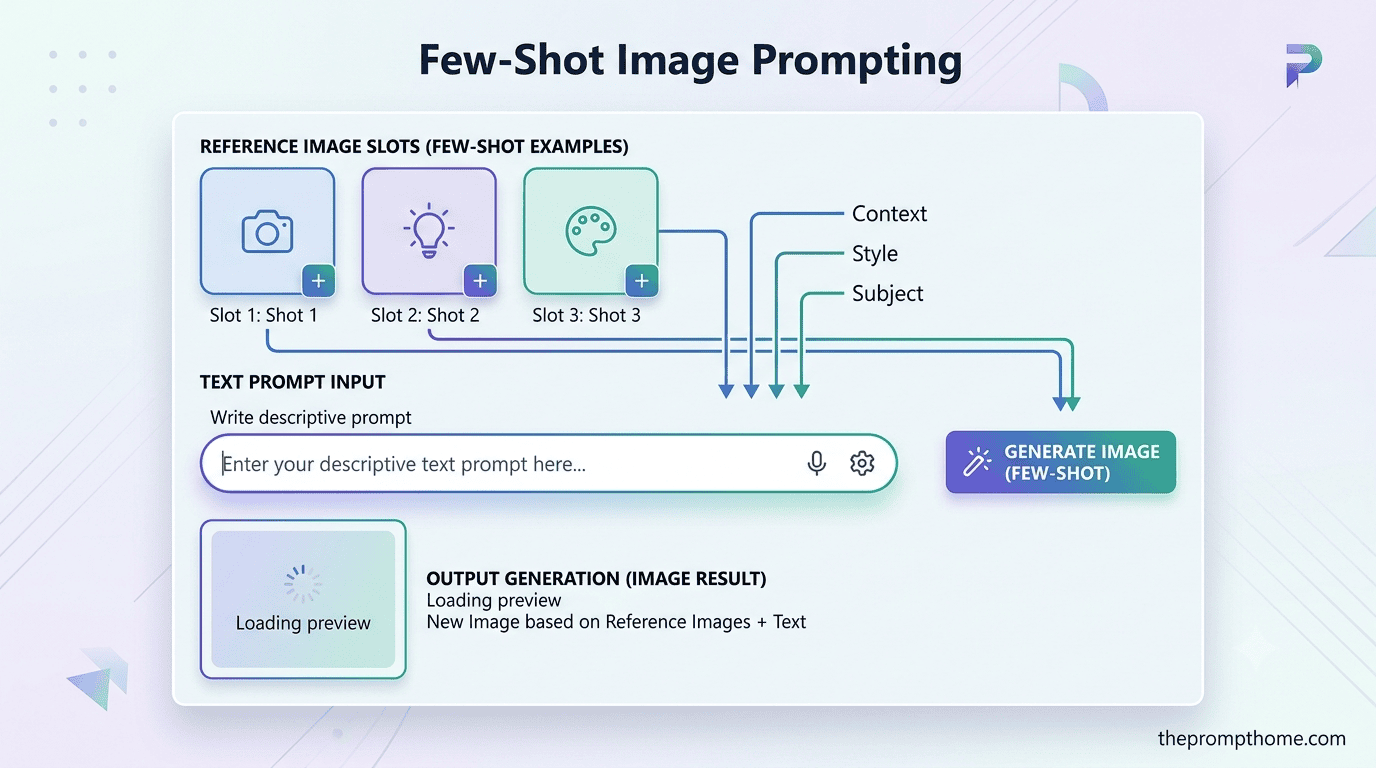
When working with image models, instead of using text examples, you upload one or two high-quality images from your computer gallery straight into the control panel. If you are using Midjourney, check out our tailored Midjourney prompt guide to see how style references work. Similarly, if you prefer other platforms, our Leonardo AI guide covers visual prompting in depth. The AI copies the core lines of those reference images and merges them with your text.
3. Chain-of-Thought (CoT) Prompting
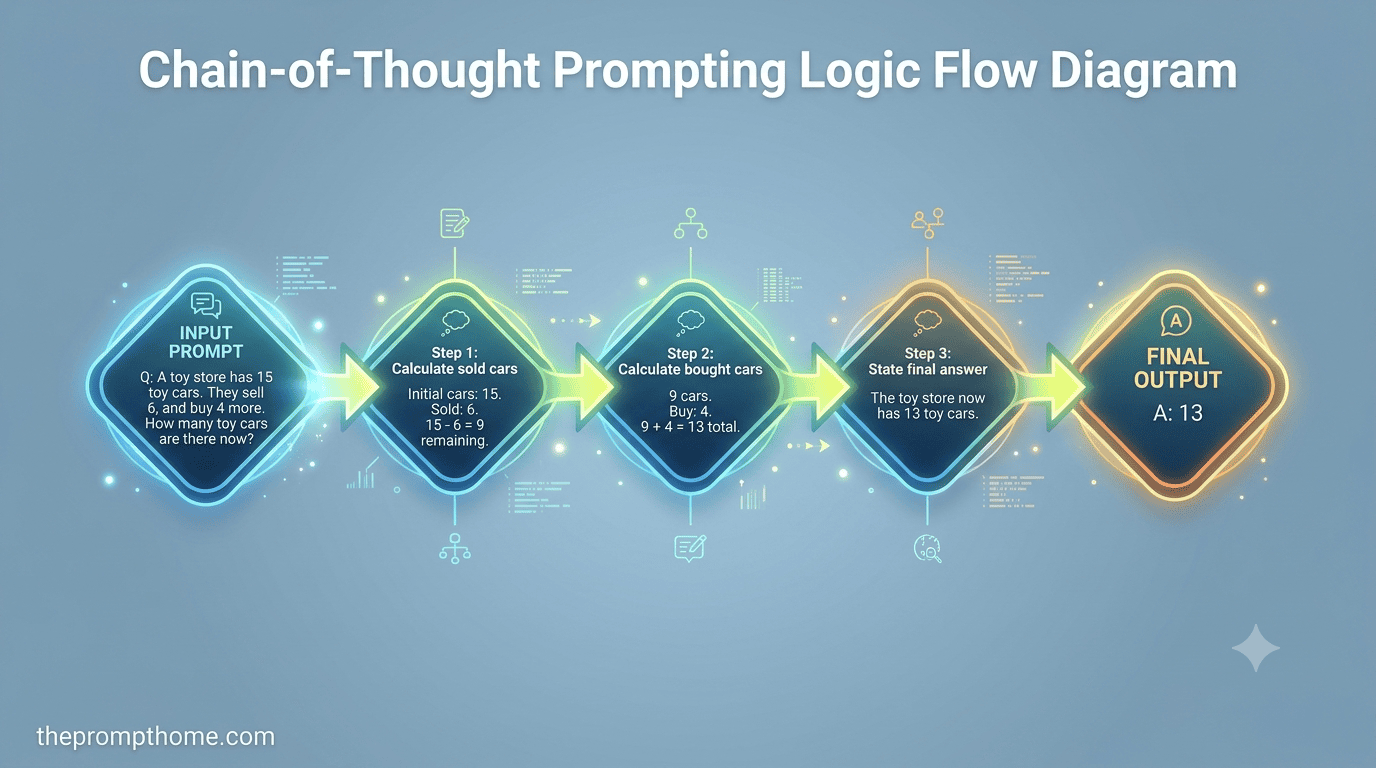
For complex mathematical problems, analytical data sorting, or deep logic puzzles, AI models can make calculation errors if they try to guess the answer too quickly. Chain-of-Thought forcing commands the model to display its internal step-by-step logic before writing down the final answer.
Without Chain-of-Thought: A user asks a complex word problem, and the AI confidently provides an incorrect final number because it rushed the process.
With Chain-of-Thought: You conclude your prompt with this exact text sentence: “Think step-by-step. Break down your math calculations into individual sequential phases, and verify the logic of each step before outputting the final numerical result.” This minor command can significantly reduce logical errors and improve reasoning accuracy.
4. Role-Based Prompting
This framework assigns a specific professional persona to the AI model before giving it a task. By changing the AI’s identity, you instantly change its internal vocabulary, priorities, and tone of voice. This technique is highly effective when building character profiles; learn more about structuring these setups in our Character Bible guide.
Text Example: “[Persona:] Act as an elite, high-converting Facebook Ad Specialist with 10 years of experience in digital marketing. [Task:] Review this uploaded product landing page copy and identify three psychological hooks we can use to target busy working mothers.”
Image Example: “[Persona:] Act as a professional interior lighting designer and 3D architectural visualizer. [Task:] Generate a wide-angle interior render of a luxury modern living room featuring biophilic elements, large glass windows, and warm ambient hidden LED strip lighting casting realistic ray-traced shadows on light oak flooring.”

Real-World Business Applications
This technical discipline is transforming corporate sectors across the globe. Here is where these engineered input systems are driving real business value:
Customer Experience Automation: Instead of using frustrating, robotic chat menus, companies use engineered scripts to turn chatbots into friendly, highly intelligent support agents that can handle product returns naturally.
Rapid Code Generation: Software developers use explicit structural parameters to generate whole blocks of clean, bug-free Python, HTML, or JavaScript, turning a five-hour coding job into a brief automated process.
Localized Marketing at Scale: Global brands use these frameworks to instantly adapt their promotional messaging for different regions, changing the cultural tone, slang, and formatting to resonate perfectly with specific demographics in the USA, Europe, or Asia.
Career Opportunities and Global Job Market
Because companies are adopting AI at a rapid pace, the demand for professionals who understand how to control these tools has increased. It has turned into an exciting and financially rewarding career path in the tech world.
Corporate Roles: Firms and marketing agencies actively hire full-time “Prompt Engineers” and “AI Content Integration Specialists” to oversee their internal automated workflows and maximize productivity.
The Freelance Economy: On platforms like Upwork and Fiverr, a massive market has emerged for custom template builders. Businesses pay premiums for specialists who can build custom image strings for product packaging, or automated email campaigns.
The Future-Proof Advantage: Even if your job title isn’t officially an engineer, adding AI input optimization to your resume instantly makes you more valuable than your peers, safeguarding your career against technological disruptions.
Professional Tools for Prompt Engineers
If you want to move beyond basic consumer chat boxes, you should familiarize yourself with the advanced platforms that professionals use to build and test their systems:
Essential AI Developer Tools
| Tool Name | Core Function | Beginner Utility |
| OpenAI Playground | Developer-focused testing environment for GPT models. | Helps beginners experiment with system instructions and adjust creativity parameters like Temperature. |
| Anthropic Workbench | Testing interface designed for Claude models. | Allows beginners to write, test, and isolate complex system instructions for long documents. |
| PromptBase | A global marketplace for pre-tested input strings. | Helps beginners study high-quality prompt structures that can significantly improve output quality. |
| LM Studio | Advanced desktop application for open-source local AI. | Enables beginners to download and test diverse open-source models completely offline for maximum privacy. |
Best Practices for Writing Professional Prompts
To wrap up your learning, remember these three golden rules used by experienced digital creators:
Be Explicit About What to Avoid: Don’t just tell the AI what you want; tell it what you do not want. Use a “Negative Prompt” section to ban robotic filler words, corporate jargon, or unwanted distortions in your visual generations.
Define the Target Audience: Always specify exactly who will be reading the output. Writing for a “first-time homebuyer” yields completely different explanations than writing for a “senior financial investor.”
Control the Structural Formatting: Never leave the layout to chance. Explicitly command the model to present its findings using specific assets like markdown headings, bulleted lists, clean code blocks, or structured HTML tables.
Official Documentation References
To understand how these systems are built from an official perspective, you can read the developer documentation provided by the industry leaders:
Review the technical prompt design guidelines on the official OpenAI Developer Platform.
Learn about context caching and structural system instructions via the Anthropic Claude Documentation.
Explore advanced large language model behaviors through the official Google AI Resources.
Frequently Asked Questions (FAQ)
What is prompt engineering in simple terms?
Prompt engineering is the art and science of writing clear, structured, and strategic instructions for AI tools (like ChatGPT or Midjourney) so they generate the exact answers, text, or graphics you need without random guessing or errors.
Is prompt engineering a real job?
Yes, it is a real and expanding profession. Corporations, tech companies, and digital marketing agencies hire specialists to build, test, and maintain custom AI prompt templates to automate operations and cut down manual production time.
Do I need to know coding to learn prompt engineering?
No, prior programming knowledge is not required. Generative AI models are built to process natural human languages like everyday English. The skill is entirely about learning how to structure your logic, outline your goals, and give clear, descriptive context.
What is the difference between a prompt and prompt engineering?
A prompt is simply the raw text line or question you type into an AI tool. Prompt engineering is the deeper, systematic process of researching, designing, and structuring that text using proven logic frameworks to guarantee a high-quality, predictable outcome.
Which AI models support Prompt Engineering?
Almost all modern AI models support prompt engineering, including ChatGPT, Claude, Gemini, Midjourney, Leonardo AI, FLUX, Ideogram, and Stable Diffusion. However, each model possesses unique behavioral patterns, meaning prompt structures may require slight adjustments depending on the platform you choose.
Can I use my own photos as image prompts without links?
Yes, modern platforms have eliminated the need for complex web links or text URLs. You can simply use the direct file upload button inside your AI dashboard to select a personal portrait or object photo straight from your mobile or desktop gallery, and then type your descriptive text prompt right next to it.
How can I learn prompt engineering as a complete beginner?
The best way to learn is through continuous hands-on experimentation. Start by using free AI tools like ChatGPT or Claude daily. Move away from vague commands and practice breaking your instructions down using structured frameworks like the C-T-I-O method (Context, Task, Instruction, Output). Analyze the AI’s mistakes and refine your wording until the output meets your standards.
Is prompt engineering difficult for beginners?
Not at all. Since generative AI models are engineered to understand natural human language, you do not need to learn complex coding syntax or advanced mathematics. If you can explain a task clearly to a human colleague using logic and specific details, you already possess the foundational skills to write high-quality prompts.
What is the best way to practice prompting?
The most effective practice strategy is the “Before and After” method. Write a simple, generic sentence and look at the basic response the AI provides. Then, rewrite that exact same prompt by adding a specific role, background context, strict constraints, and your desired formatting layout. Comparing the two results will instantly show you how AI responds to structured logic.
Can I build a career in prompt engineering without a tech degree?
Yes, absolutely. The global job market highly prioritizes practical skill and portfolio proof over formal university degrees. Companies care about whether your prompt templates can save them time and automate their business workflows. Building a clean portfolio of successful text and image generations on platforms like The Prompt Home is an effective way to attract clients.
What is a negative prompt?
A negative prompt is a dedicated section within your instructions where you list everything you want the AI to completely ignore or leave out of the final generation. For text, it helps filter out generic phrases, and for images, it eliminates background clutter and visual distortions.
Final Thoughts
The true value of artificial intelligence does not lie inside the machine itself; it lies in the human hands guiding it. Understanding prompt engineering gives you the keys to control creative and analytical engines effectively. By shifting your approach from vague commands to structured, context-driven logic, you transform these platforms into efficient assets that can help organize your brand and scale your business operations.
If you want to practice these strategies without starting from scratch, exploring pre-tested frameworks and structured examples can provide a solid starting point. You can find a comprehensive collection of free text and visual assets at The Prompt Home to help organize and streamline your digital creation workflow.
About The Author
Saleem Noor is a graphic interior decorator, digital content creator, and the founder of The Prompt Home. Drawing on his professional experience managing real-world spatial renovations and digital asset portfolios, he writes practical, straightforward guides to help creators and business owners optimize AI models for daily commercial operations. He regularly tests AI image generation workflows and prompt structures to help creators produce practical, high-quality visual assets. His work focuses on practical testing, prompt optimization, and AI workflow documentation for creators and businesses worldwide.
Create Your Own AI Portfolio Now!
Use our powerful, custom-built AI Portfolio Generation tool to turn your words into masterpieces instantly.
Try Our Free AI Portfolio 🚀Create Your Own AI Art Now!
Use our powerful, custom-built AI Prompt Generation tool to turn your words into masterpieces instantly.
Try Our Free AI Tool 🚀