4 Advanced Prompt Engineering Frameworks for Better AI Outputs
Most people think prompt engineering simply means typing a slightly better question into an AI chat box. In reality, if you want consistent, professional, and reliable results for your business, you need to move past casual conversations. Enterprise companies and elite creators don’t guess what the AI will reply; they use structured frameworks that produce more consistent and reliable AI outputs on the very first try.
At The Prompt Home, we heavily tested all four of these advanced prompt engineering frameworks across ChatGPT, Claude, and Gemini while building real-world digital marketing and coding campaigns. We discovered that by treating your everyday language like a clean piece of step-by-step instructions—aligned with the official generative standards mapped out in the Google AI Research Documentation—you can easily control the AI’s processing logic. Implementing these structural frameworks shifts your workflow from a game of lucky guessing into a predictable science.
Quick Comparison: Which Framework Should You Use?
Before diving into the technical layouts, look at this quick reference table to understand which framework fits your specific project needs:
| Framework | Best Used For | Core Strength |
| C-T-I-O | Business Emails & Marketing Copy | Eliminates robotic fluff and clichés |
| Chain-of-Thought (CoT) | Coding, Math, & Complex Logic | Helps reduce reasoning mistakes on complex tasks |
| Few-Shot Injection | Tone Mimicking & Precise Formats | Matches your exact custom writing style |
| Mega Persona | Niche Consulting & Expert Audits | Locks in professional tone and target audience |
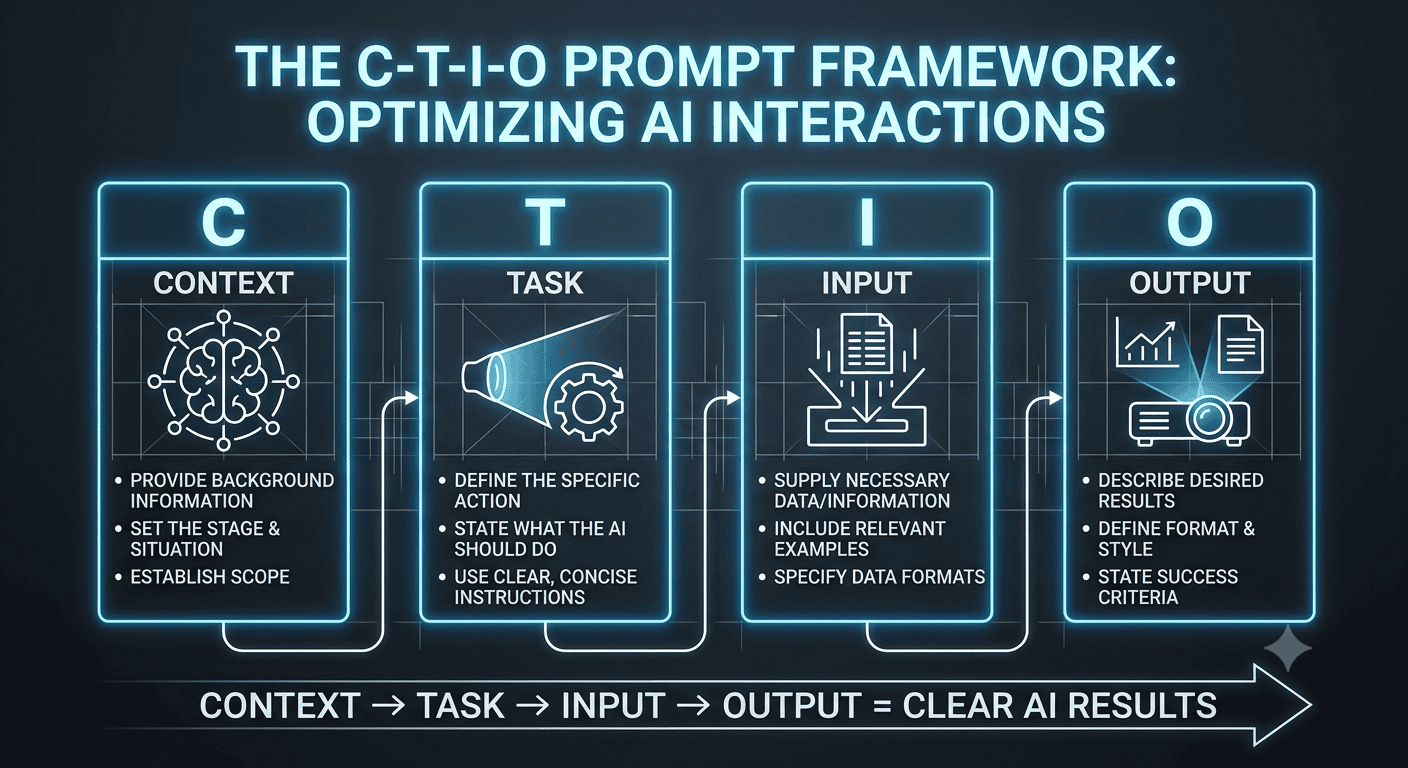
1. The C-T-I-O Framework (The Corporate Blueprint)
The C-T-I-O method is widely recognized as one of the most effective frameworks for business automation and marketing copy. It breaks down your instructions into four clear layers, making sure the AI never has to guess your underlying goals.
The Structural Formula
[Context] + [Task] + [Instructions] + [Output Format]
Our Real-World Testing: When we first tested basic, unformatted prompts to create Facebook ad copies for local businesses, the AI produced incredibly generic, boring text filled with exclamation marks. However, the moment we switched to the structured C-T-I-O framework, the output instantly became highly organized, punchy, and ready to publish.
Live Practical Example
Best Settings & Optimization
Best AI Model: Claude 3.5 Sonnet or ChatGPT-4o.
Expected Output: Three distinct, clean ad copies tailored for high-income homeowners, completely free of generic robotic filler words.
Common Mistakes to Avoid: Never mix your Task and Instructions together. Keeping what the AI needs to do separate from the rules it must follow stops the model from ignoring your negative constraints.
2. Chain-of-Thought (CoT) Framework (The Logic Engine)
AI models are statistical engines that predict the very next word; they do not naturally stop to plan their logic before answering. For complex tasks like debugging code or planning a business strategy, asking the model to give a final answer immediately often leads to errors. The Chain-of-Thought framework fixes this by forcing the AI to slow down and calculate.
The Structural Formula
[Problem Statement] + [Reasoning Rule] + [Final Verification]
Live Technical Example
Best Settings & Optimization
Best AI Model: OpenAI o1, o3-mini, or Gemini 1.5 Pro.
Expected Output: A highly educational, step-by-step written breakdown of why your code is slow, followed by a separate, clean, optimized code block.
Common Mistakes to Avoid: Don’t let the AI print the final solution first. If the model does not write out its steps beforehand, its logical accuracy drops heavily.

3. Few-Shot Context-Injection Framework (The Style Mirror)
If you need an AI tool to copy your exact personal writing voice or output data in a highly specific structural layout, simple words like “write professionally” will fail. The Few-Shot framework solves this by giving the AI direct examples to copy.
The Structural Formula
[Role Alignment] + [Style Examples] + [New Input Data] + [Action Command]
Live Practical Example
Best Settings & Optimization
Best AI Model: Gemini 1.5 Pro or Claude 3.5 Sonnet.
Expected Output:
[Sentiment: Neutral | Category: Software]without any conversational small talk.Common Mistakes to Avoid: Providing sloppy or broken examples. If your training examples contain typos, the AI will perfectly copy those exact errors into your final results.
4. Mega Persona Framework (The Virtual Expert)
Basic prompting tells the AI to “act like a marketer.” The Mega Persona framework builds a hyper-detailed virtual specialist by locking in their years of experience, specific tool proficiencies, and exact target demographic.
The Structural Formula
Live Consulting Example
Best Settings & Optimization
Best AI Model: ChatGPT-4o or Claude 3.5 Sonnet.
Expected Output: A highly professional, critical audit that identifies weak psychological hooks on your page and suggests high-conversion alternatives.
Common Mistakes to Avoid: Forgetting to mention your target market. Without defining the geographic and cultural audience, the AI persona defaults back to generic global writing styles.
Frequently Asked Questions (FAQ)What makes aAdvanced Prompt Engineering Frameworks?
An advanced framework moves away from casual chatting. It uses strict, rule-based structures to treat the AI model like a functional programming engine, leading to highly predictable and professional business assets.
Why does Chain-of-Thought prompting reduce mistakes?
By asking the model to write out its reasoning steps sequentially before giving a final answer, you ground its logic. This linear progression keeps the model focused on the facts it just processed, helping reduce reasoning mistakes on many complex tasks.
How many examples do I need for Few-Shot prompting?
For most standard copywriting and data sorting workflows, providing 2 to 3 high-quality, accurate examples is more than enough. Adding too many examples can waste your token limits.
Can these frameworks be used across different AI tools?
Yes. These frameworks can generally be applied across different AI tools and models. Whether you prefer using ChatGPT, Claude, or Gemini, the underlying structural logic of these frameworks remains consistent.
How do I stop the AI from writing useless conversational text?
The most effective way is using strict negative constraints within your C-T-I-O or Few-Shot layouts. Explicitly commanding the AI to “skip introductory text” or “output only raw data” cuts out conversational fluff instantly.
Final Thoughts
Mastering these four frameworks completely eliminates randomness from your generative AI workflows. By organizing your everyday language into clear blueprints, logical sequences, and expert personas, you gain total control over your digital output. Stop guessing what the AI will reply, start engineering your text inputs, and transform your daily dashboard into a high-performance business asset!
.
About The Author
Saleem Noor is the founder of The Prompt Home, where he publishes practical guides on prompt engineering, generative AI, AI image creation, and AI video workflows. His work focuses on helping creators, marketers, and businesses achieve better results through structured prompting techniques and real-world AI strategies. His goal is to bridge the gap between human creativity and machine intelligence by delivering clear, practical, and educational content.
Create Your Own AI Portfolio Now!
Use our powerful, custom-built AI Portfolio Generation tool to turn your words into masterpieces instantly.
Try Our Free AI Portfolio 🚀Create Your Own AI Art Now!
Use our powerful, custom-built AI Prompt Generation tool to turn your words into masterpieces instantly.
Try Our Free AI Tool 🚀